How to Build a Compelling Business Case for Linear
Tech
Most teams pitch Linear as a sleek upgrade 'everyone is using now'. But tools don’t get approved because they’re sleek, they get approved when leadership clearly sees the cost of your current workflows and the operational upside of switching.
Here’s the exact structure to make your case undeniable.
1. The Pain (Current State)
Approval accelerates when your manager can feel the friction your team experiences today.
Typical pains when teams are not using Linear:
it's too customisable, which makes it easy for people to develop painful workflows and systems. When consistency is at zero and everyone has to do things differently in every single project, the whole team wastes time context switching
That lack of clarity can lead to blown out projects and a lack of understanding as to what initiatives projects even relate to
Hard to understand true delivery velocity
Engineering time wasted in status meetings and manual updates
No tight connection between product roadmap, cycles, and day-to-day work
Context switching between tools reduces deep-work time
Bugs and tasks get lost because workflows aren’t automated
Add directional numbers if you can:
“Developers spend 3–5 hours a week updating Jira or responding to status pings.”
“Two launches slipped last quarter because blockers weren’t surfaced early - in [insert your tool] this occurs because [clear reason].”
“We maintain three different sources of truth (roadmap, sprint board, backlog).”
The clearer and more concrete the pain, the easier it is for leadership to approve the change.
2. Desired Outcomes
Tie Linear directly to measurable improvements in speed, clarity, and engineering efficiency.
What Linear unlocks:
A single, elegant workflow for roadmap → cycles → tasks that benefits all teams
Faster issue creation and triage, reducing PM/engineering overhead, with agent integrations an option, allowing the team to easily leverage AI
Real-time velocity insights and progress tracking
Dramatically less admin, more time spent building
Fewer meetings because alignment becomes asynchronous and automatic
Anchor these outcomes to business objectives:
“Moving to Linear increases throughput, reduces engineering admin by 30–40%, and shortens cycle times, allowing us to deliver more without adding headcount.”
3. Options Considered
Managers want proof that your recommendation is strategic, not reactive.
Status Quo
Keeping the current system guarantees existing inefficiencies remain. As the team scales, the cost of misalignment grows.
Other Tools (Jira, Asana, ClickUp, Notion)
Be clear but fair about why they’re not the best fit:
Jira: powerful but heavy; slows teams with configuration overhead
Asana: not built for engineering workflows or velocity tracking
ClickUp: flexible but complex; long onboarding curve
Notion: great for docs, weak for issue tracking at scale
Why Linear Wins
Extremely fast and intuitive for engineers (reduces adoption risk)
Clean, opinionated structure that prevents process sprawl
First-class support for roadmaps, cycles, and scoped work
Saves time through built-in automations and keyboard-driven UX
Strong analytics with no setup required
Integrates smoothly with GitHub, Slack, Figma, and more
Talk about the other options without a silly level of bias to your preferred outcome, this section shows you’ve evaluated the decision with CFO-level rigor.
4. Cost and ROI
A strong business case doesn’t require perfect accuracy, directionally correct numbers are enough. Demonstrate you understand this aspect of things.
Current Subscription Cost v Linear
A table is useful here. If you don't know current costs, speak to someone in finance or invite them into Riff.
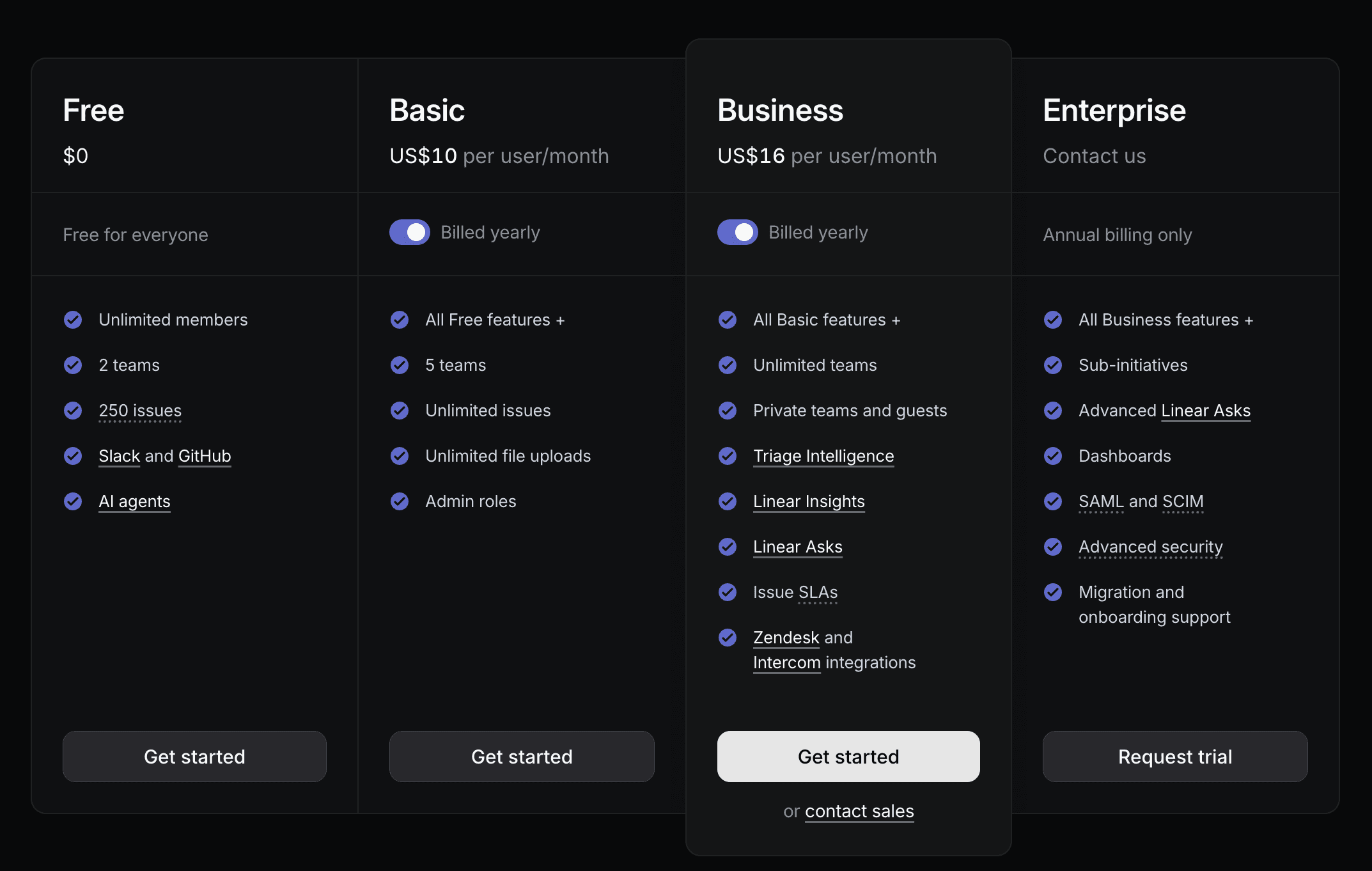
Here are Linear's costs.
Licenses: ~$X per user per month
Implementation: minimal because Linear is nearly zero-setup (this will vary on company size)
Estimated annual cost: $X
Migration cost: (if you've been using another platform for years, how long will it take to replicate what you have, consider asking the vendor what support they can offer here, smart ones often say they'll do it all for you)
Don't be naive to switching costs, it reads better if you've shown you get it and include an estimate than pretend 'switching is free' - no, no it is not.
ROI Examples
Where Linear typically produces value:
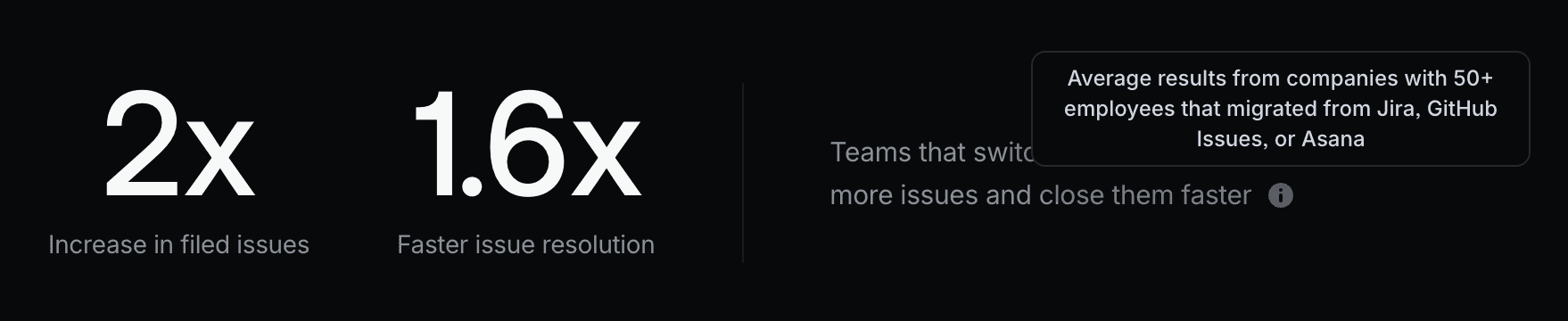
Less manual reporting → ~2–4 hours saved per engineer per week
Fewer sync meetings because alignment lives in Linear
Faster cycle times → more features delivered per quarter
Reduced operational overhead = delayed need for additional PM/eng hires
Fewer dropped tasks → lower risk and smoother launches
A helpful framing:
“If Linear saves each engineer just 3 hours per week, that’s ~150 hours per person per year. At an average loaded cost of $X/hour, that’s $Y in regained productivity, far exceeding the tool cost.”
Decision-makers approve when value overwhelmingly outweighs cost.
It can help to point at companies like yours that have clearly seen the ROI and have shared a case study, there are examples here.
5. Implementation Path (Minimising Risk)
Show leadership that rollout is going to be well managed. For larger organisations, define a pilot to assess whether your assumptions meet reality. Suggest who, how long and what you'll measure.
By making the rollout phased and reversible, you reduce perceived risk.
Linear provides a clear guide on how to do this practically.
The One-Page Business Case Template
Copy, paste or save yourself a heap of time by asking Riff to prepare the business case for you, completely custom to your org.
Request for Approval: Move to Linear for Engineering & Product Workflows
1. Problem / Current State
Our team currently relies on a mix of tools (____). This leads to:
X hours/week spent updating or requesting status
Unclear ownership of issues and roadmap items
Slow or inconsistent sprint progress visibility
Duplicate work and preventable delays
Increased coordination overhead as we scale
[concrete examples where you can point to the current process as a good part of an real issue]
2. Proposed Solution: Linear
Adopting Linear will:
Centralize roadmap, cycles, and tasks
Automate updates and reduce manual admin
Improve delivery speed and surfacing of blockers
Provide real-time progress visibility for leadership
Save an estimated X–Y hours per team member per month
3. Options Considered
Status Quo: Inefficiencies and delays persist
Other Tools: [List limitations clearly]
Recommended: Linear for its speed, simplicity, automation, and fit for engineering teams
4. Cost and ROI
Estimated annual cost: $X
Estimated saving on current costs: $X [if relevant]
Estimated productivity gain: X hours/month
Value of time regained: $X/month
Additional benefits: improved predictability, fewer delays, reduced coordination overhead
Expected ROI: within X months
5. Implementation Plan
In March we propose trialling Linear with the Payments team - 10 developers, 1 PM and 1 designer. We will replicate our current projects and tickets from Jira into Linear (expecting this will take less than 2 hours). We will trial linear for 4 sprints and report back on whether our assumption on time savings, ease of use and speed to ship are realised.
Plan:
Week 1: Create core projects, set up cycles, import issues
Week 2: Pilot with one squad (engineering + PM + design) for 4 sprints
Week 3: Roll out templates, automation, and integrations
Week 8: Approval stage gate: Expand to full team
6. Recommendation
Approve an 8 week trial before approving a 12-month Linear subscription to reduce inefficiency, increase velocity, and support scalable product delivery - saving [$X per annum].
Riff Helps You Get a Decision Faster
Most AI tools give you fluffy irrelevant text you still have to rewrite. Riff helps you stress-test assumptions, it asks the questions your manager will so you look 10x more prepared, you can involve multiple collaborators and build a polished, manager-ready business case in minutes.